Appalachian Sustainable Agriculture Project - Home

Home > Research > Case Studies > Cane Creek Valley Farms


Buy Local - Buy Appalachian Local Food Guide!
Local Food Guide

Home

Local Food Campaign

Growing Minds

Calendar

Partners

Vision and Mission

Links

Contact


Cane Creek Valley Farms: Catching Up to Stay in Place

By Ginger Kowal

At the end of her first season as a full-time farmer, Amanda Sizemore barely has time to stop and talk. “I never stop going, I’m always running around like a chicken with my head cut off! On this farm, I’m really just trying to keep up with my dad.” She is obviously exhilarated. She seems to almost jump out of her seat with visible excitement.

Amanda is the fourth generation of her family to work the land of Cane Creek Valley Farm in Fletcher, North Carolina, but the very first to market organic produce. In her first season on the farm, she managed fifteen certified organic gardens and the small produce stand where the products of the garden were sold to passersby on busy Cane Creek Valley Road. It didn’t take her long to realize that her fifteen gardens were producing way too much volume to be sold at the small farm stand; so in the same season, she began marketing her organic vegetables to half a dozen outlets on the wholesale market. At the end of the season, she says, “I realized I had just no idea how much there was to it!”

Amanda shares responsibility for this brand-new operation with her father, George Nesbitt, who grew up working the family dairy on the farm and who still maintains a medium-sized dairy on the property. Like most other dairies operated in North Carolina, the Nesbitt family dairy is facing rapidly mounting financial pressures from the milk market and from regional development. As the land around the dairy has been sold piece by piece to homesite developers, less and less of it is available for Mr. Nesbitt to lease in addition to the 100 acres that he owns. Profit margins for the small family dairy are decreasing drastically in a global market for commodity milk. And so two years ago, Amanda and her dad started looking for alternative ways to continue the farm. “We just love farming, and we want to keep the farm going. We were looking for the best way to be able to do that.”

Amanda had just graduated with a degree in Horticulture, and she and her father investigated every available crop that could be grown on the farm to maximize returns and make the family land profitable again. “We looked at it all, cut flowers, nursery crops, you name it,” Amanda says. “The n we went to a workshop on small-scale organic production, and we thought, ‘Hey, there might be a future in this one.’”

As they embarked on their transition from one highly specialized market to another, Amanda and her father faced some challenges that are unique to dairy farms, and some common to most small farms in western North Carolina. Because of the significant on-farm equipment that is required of, such as milking parlors and facilities for animal care, dairy farmers must make a large financial investment just to operate. This makes it more difficult for dairy farmers to switch from one kind of production to another; unlike crop farmers, who may only have to change a few pieces of equipment to grow one crop instead of another, dairy farmers must make drastic changes to their farm to cross from dairy into another kind of production.

Amanda and her father also had relatively small amounts of acreage to work with, and lacked the infrastructure for processing of vegetable products or for distribution to distant markets. Although declining profits in the dairy business and encroaching development of nearby land made it clear to both of them that some sort of transition would be necessary to keep the family farm in business, the choice of what kind of transition to make was treacherous. Amanda knew that she had to be careful in choosing the market to enter, and that that choice would rest primarily on available markets. She also wanted to choose a new method of production that would build on the assets that the farm already had.

Amanda and her father decided that there was a future in organic production primarily because there appeared to be a ready and vibrant market for it. There were also some advantages inherent in the structure of the family farm and its history as a dairy that made the transition to organic vegetable production easier than it might have otherwise been. “Because this bottomland had only ever been in pasture, we had never put any chemicals on it at all,” Amanda explains. “So to get it certified organic, instead of going through the three-year process, it only took us a year.” And because the dairy is adjacent to the organic cropland, 90% of the gardens’ fertilizer needs are met by spreading manure from the cows. “That cuts down on our input costs tremendously, which is a big downside of farming organically. This way, our returns are much higher.”

But although the integration of the vegetable gardens with the family dairy has proved an asset to production, the most difficult part of the operation has been not the growing, but the marketing of the vegetables. Although demand for local produce and certified organic products appeared to be high, the challenge of finding and entering that market in western North Carolina outlets still remained. As Amanda explains, “Farming is really all about paying attention to markets, changing and evolving with them. And that’s the hardest thing for us now – we can grow anything! But can we sell it?”

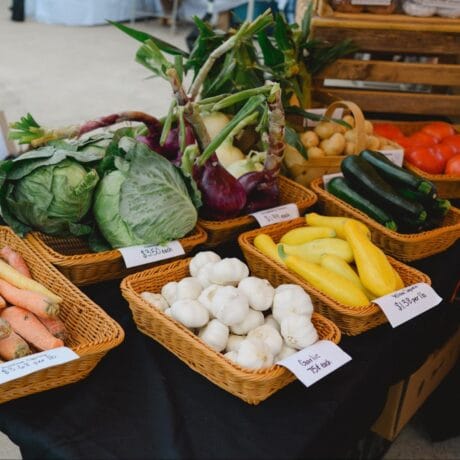
Amanda’s original plan for marketing her certified organic vegetables was through the on-farm produce stand, which she set up to be the main outlet for her organic gardens but also for other local producers. “I love the idea of farms in a community, supporting the community. I wanted to make our stand a hub for the local growing community.” She brought in local jams, dairy products, baskets and other crafts, and local produce that she wasn’t growing on the farm. And although she expected to pull in customers locally because of the certified organic produce that she was able to offer, she found that it was the freshness of the produce that appealed to the farm stand customers instead. “People were just happy to have fresh produce,” she explains. “And we had some loyal customers, but not enough customers to buy everything that we were producing.”

And so not far into her first season of growing, Amanda approached grocery store buyers, larger markets that responded with the enthusiasm that she expected for certified organic produce. “I received a lot of help from one person at the first Earth Fare store that I went to,” she says. “And buyers at the other stores that I talked to were excited to be able to get organic produce that was also local.” Some of the stores that she began to deal with had been discouraged from selling organic produce because it wouldn’t last on the shelves; they found that in the time that passed before it was sold, the produce quality would deteriorate until it didn’t merit the higher price usually charged for organics. “I told them they wouldn’t have that problem with our produce,” says Amanda. “Because ours is picked and shipped that same day. And it doesn’t go far.”

To facilitate distribution to the outlets that were enthusiastic about certified organic produce, Amanda began selling to three produce brokers and directly to three more large-scale retailers. Through backhauling from local stores to central warehouses and distributing some of the farm produce herself, Amanda is able to get Cane Creek Valley Farm produce to a variety of different buyers. “I wish that I could sell more directly,” she says, “But I just don’t have the time or the resources to be peddling vegetables all over the place. The money in the market really comes from the wholesale market, and that’s where I have to put my energy now.”

Fortunately, it’s not just Amanda’s energy that is being put into the new venture. She is the oldest of nine children in a family that is still very much centered around the farm. “My father and I wanted to make it so that all of my siblings could get involved in some way,” says Amanda. “We incorporated so that anyone from the family who had an idea for their own business on the farm could buy a share and run that part themselves.” One of her brothers-in-law has a plan to start organic blueberry cultivation; another sister, an education major in college, is interested in returning to the farm and integrating it with elementary school curricula. “Almost all of my brothers and sisters came out and worked in the fields with us last season,” Amanda laughs. “They all just wanted to be out there. It’s fun for us to be working on the farm together.” Two of her younger brothers, high school students, charmed customers at the produce stand. Amanda’s own children, aged 2 and 9, are homeschooled on the farm so that they too can be involved. “My dad grew up on the farm; my siblings and I grew up on the farm. I want my children to learn how to work on the farm and have that experience.”

Providing a place for everyone in the family to participate on the farm is at the very heart of the new operation. “That’s why we’re doing all of this – to be on the farm.” Amanda hopes that in the next year, organic certification will be extended to an additional twenty acres, and possibly to sixty acres of the dairy eventually. “It’s fun!” Amanda laughs. “I want it to keep working!”

Find Cane Creek Valley Farm in the Local Food Guide!

TOP

Home

Send comments or suggestions to webmaster@asapconnections.org

©Copyright 2005 Appalachian Sustainable Agriculture Project
729 Haywood Rd., Asheville, NC 28806 -Join the ASAP E-mail List serve
Voice: 828-236-1282 or fax: 828-236-1280 email: info@asapconnections.org
Appalachian Sustainable Agriculture Project is a 501(c)(3) nonprofit organization.

Google
Search WWW Search asapconnections.org

Click here to Donate Now